Switchboard: abusing uaf and double free in kmalloc-cg-32
published:
TL;DR
kUAF and double-free in kmalloc-cg-32 without CONFIG_SLAB_FREELIST_HARDENED
Challenge Description
This challenge was part of PatriotCTF 2025.
Your standard SLAB notetaking app!
Category: pwn
Exploitation
Analyzing the source code
For this challenge we are provided with the source code switchboard.c that implements a switchboard kernel module, with different device management operations. It uses the switch_device struct:
struct switch_device {
    char *buf;
    void *head, *tail, *seek;
    int len;
    uint8_t inuse;
    uint8_t freed;
    unsigned long t_settings;
};
Device operations:
obj_new: Creates a new switch_device object, allocates a 32-byte buffer, initializes all pointers to the buffer start, setsinuse=1, and adds it to the global list.obj_select: Selects a device by index from the device list.rx_handle:copy_from_userhandler. If the deviceinuse==0, it allocates a new 32-byte buffer first.tx_handle:copy_to_userhandler. Usesdev->t_settingsfor retransmission.buf_reset: Sets seek=head and marks device as not in use (inuse=0). If already not in use, frees the buffer memory.n_set: Sets the maximum data length for the selected device's buffer, stored indev->len.settings: Configures transmission settings for the selected device. The t_settings field uses bit 0 to control retransmission behavior in tx_handle.
There are two major issues in the module, after freeing a specific node reseting its buffer with buf_reset, the pointer is not cleared, leading to a use-after-free vulnerability. This is critical considering that there are no modern protections such as CONFIG_SLAB_FREELIST_HARDENED, that prevent the tampering of slab freelists. Added to this, the r/w handlers do not check if the object is freed. The other problem is at buf_reset, where after freeing a node we set dev->freed = 1, but there are no checks that use this field so we can infinitely free a chunk.
static long buf_reset(unsigned long arg){
    struct switch_device *dev = get(selected);
    if(!dev)
        return -1;
    if(dev->inuse == 0){ // <- There are no checks to see if it is already freed
        kfree(dev->buf);
        dev->freed = 1; // Set freed to 1
        return 1;
    }
    dev->seek = dev->head;
    dev->inuse = 0;
    return 0;
}
Exploiting the vulnerability
With this information we know that we can achieve a write-what-where primitive in the kernel, but to achieve root in the VM we need to leak kernel base address. To do this we are going to take advantage of seq_operations object.
We know that the allocation that is happening in the module is of size BUF_SIZE: dev->buf = kzalloc(BUF_SIZE, GFP_KERNEL_ACCOUNT), so we know the object ends getting placed in a kmalloc-cg-32 slab. In the linux kernel, caches are shared across the system, so we can abuse this fact by allocating an object that we know that contains kernel pointers and read them using our kUAF to leak kernel addresses.
The seq_operations object is placed inside kmalloc-cg-32 when opening the file /proc/self/stat and it is freed when closed. This object is often used to achieve RIP control by overwriting one of its pointers with an arbitrary address, but in our case we will only leak kernel base using the first pointer in the structure. More info here.
struct seq_operations {
	void * (*start) (struct seq_file *m, loff_t *pos); // <- We will read this one and calculate the offset to kernel base
	void (*stop) (struct seq_file *m, void *v);
	void * (*next) (struct seq_file *m, void *v, loff_t *pos);
	int (*show) (struct seq_file *m, void *v);
};
Knowing this we can follow the next approach to leak kernel pointers:
- Double free a device object. After double-freeing an object the freelist gets tampered and gets stuck in an infinite loop, so we know that our next object will be 100% allocated here.
- Allocate a device (we do this first because it is using
kzallocto zero out previous content) - Because it is freed again, we can place
seq_operationsinside by callingopen("/proc/self/stat") - Read from the device to get leaks
After getting leaks we can just free twice again an object and write over its next pointer to allocate wherever we want right? There is a problem, when creating an object we allocate twice in kmalloc-cg-32, this is because in the obj_new function we allocate once for dev->buf (the one we are interested in), and it calls add() to add the created device to the linked list. This last function allocates a struct devices object that is an entry in the linked list, so it has 3 pointers (24 bytes), and gets allocated in the same cache.
typedef struct devices {
    struct switch_device* device;
    struct devices* next, *prev;
} devices;

static ssize_t add(struct switch_device* dev){
    devices * node = head;
    devices * newdev = kzalloc(sizeof(devices), GFP_KERNEL_ACCOUNT);
    ...
}
For this reason, we will create an additional object on index 1 before leaking, and we will free it after tampering the free list, to place it on top of the list.
One way of achieving root execution with an arbitrary write primitive in the kernel, is overwriting the modprobe_path global variable. It usually contains a string /sbin/modprobe, that is a binary that gets executed whenever the kernel does not recognize the magic bytes of a file. If we overwrite this string with a custom shell script, and try to execute an unknown file (for example, one that starts with 4 0xff bytes), our shell script will get executed as root.
Achieve LPE from the powerful primitive
The final path for the exploitation is:
- Double free the object 0
- Write into its next pointer the address of
modprobe_path - Free once the object 1, our free list now is
modprobe_path<-node0<-node1. - Create a new object to allocate node1, and node2
- Call the write handler to allocate and write into
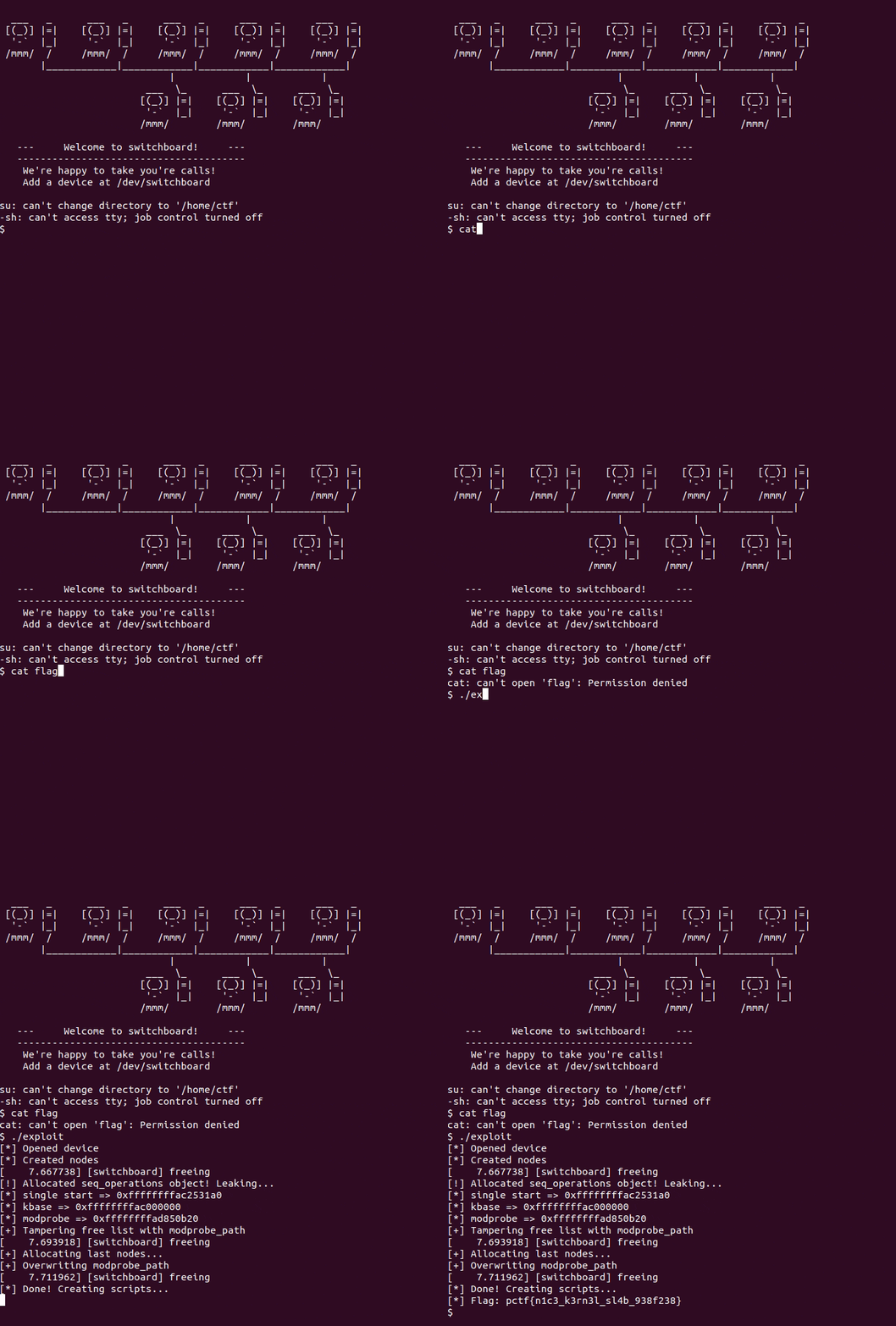
modprobe_path - Create the shell script, and the dummy file, execute it and read the flag.
I added some usleep calls in the exploit because it was not consistently getting the flag, I thought it was because of timing issues.
Getting the flag
Solvers
You can find the solver here.